CHANGE MANAGEMENT
What is a change impact assessment?
Last updated: May 2026
Paul Clavering · Founder, theChangeTracker & Just Enough Change Ltd
A change impact assessment is how you identify what is actually changing for the people in your organisation. Not the technical changes, the system upgrades, the new processes on paper, but the human reality of what is different and who it affects. Done well, it shapes everything that follows: your training plan, your communications, your stakeholder engagement. Done once and filed away, it is worth very little.
Key statistics
70%
of change initiatives fail to achieve their goals
Source: Prosci longitudinal research
88%
of projects with excellent change management met or exceeded their objectives
Source: Prosci Best Practices Research
6x
more likely to meet objectives with excellent change management than with poor change management
Source: Prosci Best Practices Research
The CROPS framework
Every change impacts people differently. The CROPS framework gives change managers a consistent way to categorise those impacts across the four dimensions most likely to affect how people work.
Culture
Changes to how things are done, team norms, ways of working, or organisational values and behaviours.
Responsibilities
Changes to job roles, reporting lines, accountability, or what people are expected to own and deliver.
Operations and Processes
Changes to day-to-day tasks, workflows, procedures, or how work gets done end to end.
systems
Changes to the tools and technology people use. systems facilitate change but do not define it.
Why impact assessments fail
Most impact assessments fail for the same reason. They are treated as a document to produce rather than a practice to maintain. A change manager maps the impacts at the start of a programme, files the spreadsheet, and moves on. Six weeks later the programme has evolved, new impacts have emerged, and the assessment is already out of date.
The second failure mode is scope. Individual project teams assess their own impacts in isolation, with no visibility of what else is being asked of the same people at the same time. An impact that looks manageable on its own looks very different when it lands alongside five others hitting the same team in the same month.
According to Prosci research, projects with excellent change management are nearly seven times more likely to meet their objectives than those with poor change management. The quality of your impact assessment is one of the most direct levers you have on that outcome.
The three lifecycle stages
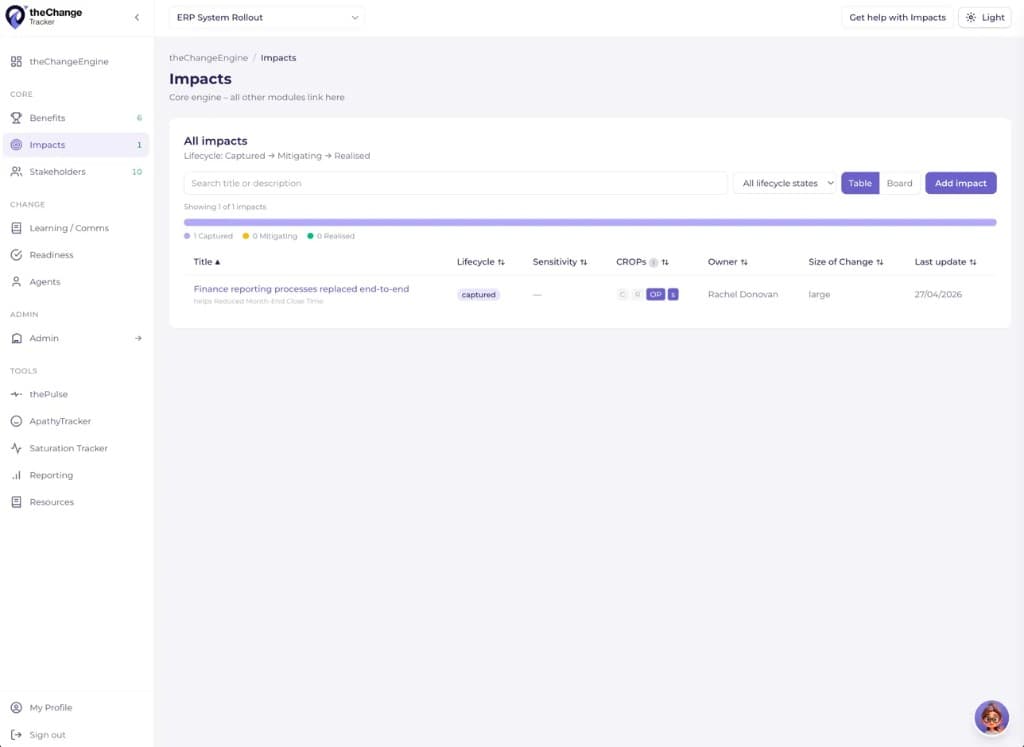
In theChangeTracker, every impact moves through three stages. This turns a static document into an active management tool.
- 1
Captured
The impact is defined. What is changing, how it affects the people involved, and what will be done to address it. This is where you establish the as-is state, the to-be state, and the mitigation plan.
- 2
Mitigating
Active work is underway to address the impact. This could be training sessions, communications, stakeholder engagement, or process walkthroughs. The impact is being managed, not just recorded.
- 3
Realised
The mitigation is complete. Everything that can reasonably be done has been done. The impact moves to Realised not because the change is painless, but because the organisation has done its part to support people through it.
This lifecycle mirrors how theChangeTracker handles benefits, which move from Defined through Measuring to Closed. Consistent language across the platform means your whole team understands where things stand at a glance.
How impacts connect to the rest of your programme
In theChangeTracker, impacts sit at the centre of the core process. Each impact can be linked to a benefit, making the connection between what is changing and why it matters explicit. That link also means your training and communications activities, logged in the Learning and Engagement Hub, can be tied back to the impacts they are designed to address.
Breaking your benefits down into smaller, measurable components makes this even more powerful. A single large benefit, like improved operational efficiency, is hard to track and harder to attribute. Five specific benefits, each linked to the impacts that drive them, gives you a much clearer picture of whether your change is working.
In theChangeTracker, stakeholder groups sit in the CORE workspace alongside impacts and benefits: the WHO alongside the WHAT and WHY. For how to plan that pillar well, read our guide to stakeholder mapping in change management.
How theChangeTracker helps
PRODUCT APPROACH
A living assessment, not a filed document
theChangeTracker treats impact assessments as an active part of programme delivery, not a compliance exercise. Each impact has an owner, a lifecycle stage, and direct links to the benefits it supports and the training and communications designed to address it. As impacts move from Captured to Mitigating to Realised, you have a real-time view of where your change programme stands.
Start your impact assessment today
theChangeTracker gives you a structured, connected way to capture, manage and realise your change impacts. Free to start, no credit card required.
Try theChangeTracker freeSources
- Prosci Best Practices in Change Management research. Available at prosci.com
- Prosci longitudinal research on change management success rates