CHANGE MANAGEMENT
What is change saturation?
Last updated: 1 May 2026
Paul Clavering · Founder, theChangeTracker & Just Enough Change Ltd
Most organisations are running multiple change programmes at once. When the cumulative demand placed on people exceeds what they can reasonably absorb, change saturation sets in. Here is what it means, what the research says, and how to manage it.
Key statistics
73%
of organisations are near, at, or beyond the saturation point
Source: Prosci Best Practices Research
53%
of employees feel overwhelmed by too much change at once
Source: Prosci, 2026
42%
decline in employee intent to stay in high-saturation environments
Source: Gartner
Why it happens
Organisations rarely run a single change programme. ERP rollouts, HR system updates, process redesigns, and compliance initiatives all land on the same departments at the same time. Each project team focuses on its own delivery, with little visibility into what else is being asked of the same people. Understanding the full picture starts with a rigorous change impact assessment.
The cumulative load builds invisibly until it becomes visible as resistance, missed deadlines, low adoption rates, or people leaving. By that point, the damage is already done.
If the signals are there but the limit has not yet been breached, you may be dealing with change fatigue rather than saturation. Read our guide to understanding the difference.
According to Prosci research, 54% of employees experiencing change fatigue actively look for a new role, and 37% report trusting their employer less as a result.
Signs your organisation is approaching saturation
- Low adoption rates despite training being completed
- Increasing resistance to new changes across teams
- Missed project deadlines without clear cause
- Managers reporting their teams feel overwhelmed
- Rising attrition in departments carrying multiple changes
- Declining performance scores and increased error rates
How theChangeTracker measures it
PRODUCT APPROACH
Tracked by role, not by individual
theChangeTracker measures change saturation at the role level rather than the individual level. This keeps the view practical and non-personal: you can see where pressure is building across your organisation without singling out specific people. Every learning event, engagement activity, and communication that touches a role contributes to its saturation score.
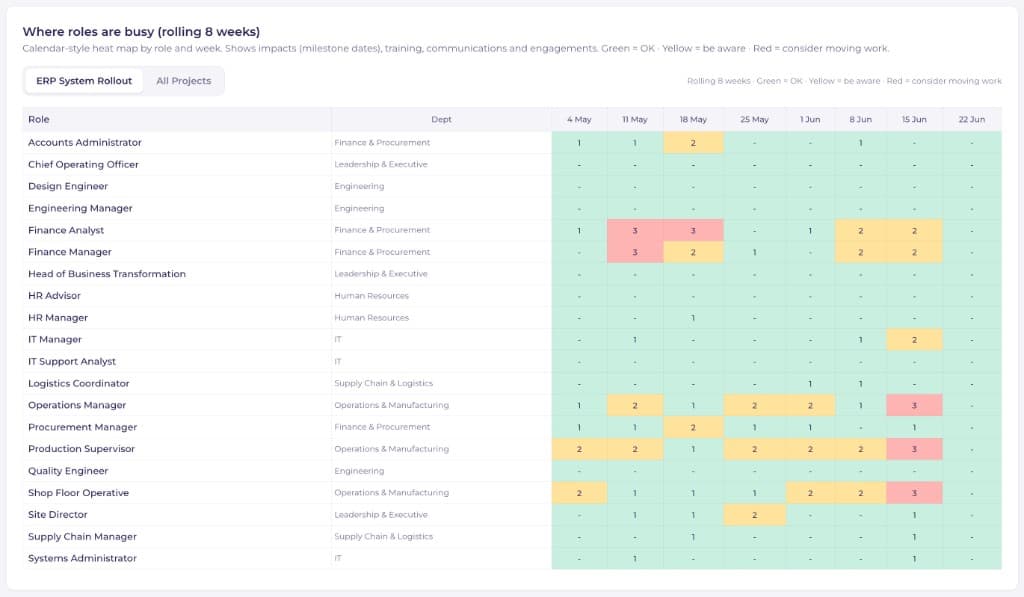
The Saturation Tracker uses an 8-week rolling window. As learning events, training sessions, and engagement activities are logged, the tracker updates in real time, showing which roles are approaching their limit and where scheduling decisions need to be made before saturation becomes a problem rather than after.
See change saturation before it becomes a crisis
theChangeTracker gives you a live view of cumulative change load across every role in your organisation. Free to start, no credit card required.
Try theChangeTracker freeSources
- Prosci Best Practices in Change Management research. Available at prosci.com
- Gartner research on change fatigue and employee intent to stay, 2026
- Prosci, Five tips for addressing change saturation, 2026